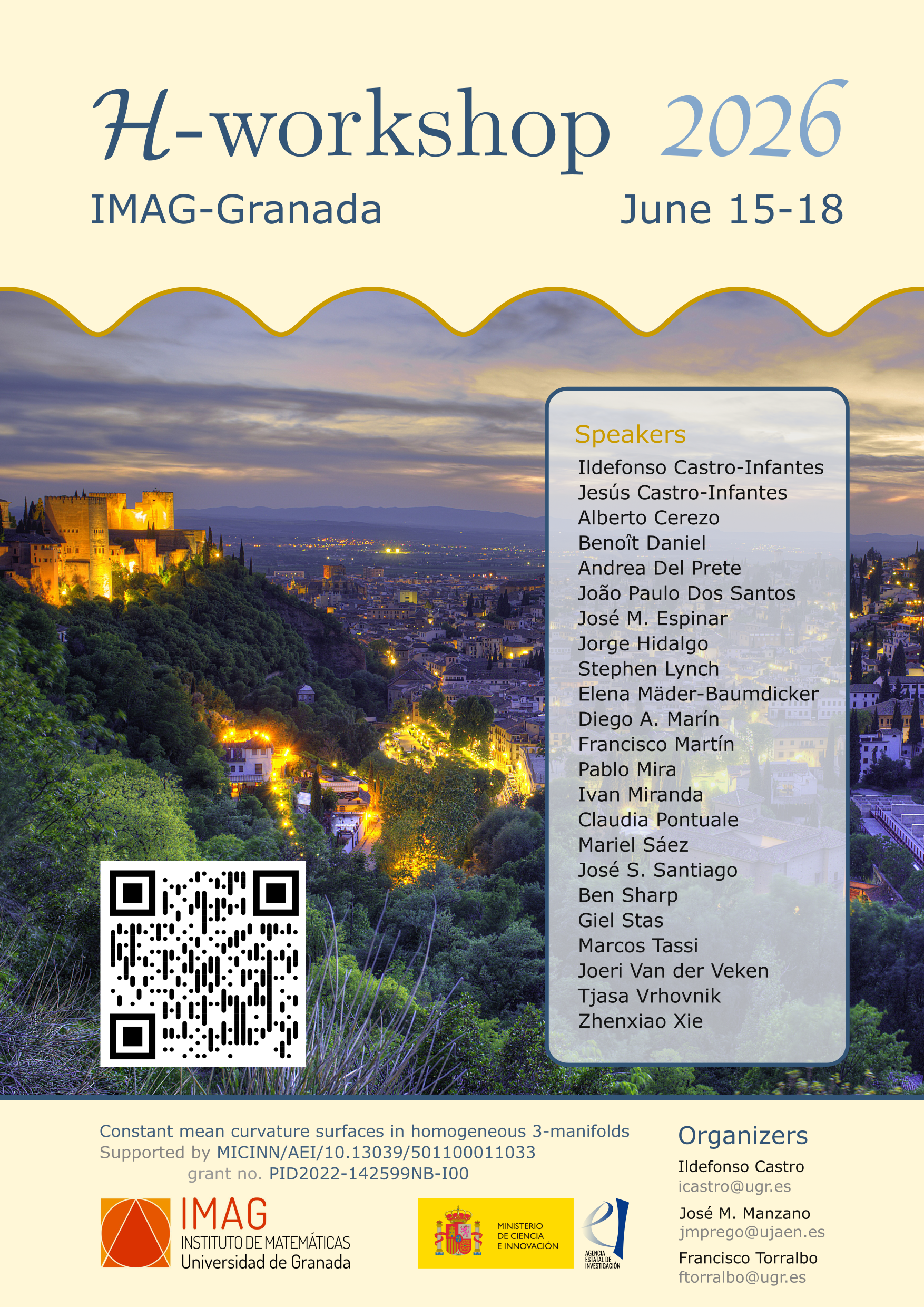
Constant mean curvature surfaces and related areas of submanifold theory represent a classical field of research that uses techniques from both Differential Geometry and Geometric Analysis. The aim of this \(\mathcal{H}\)-workshop is to gather together some distinguished geometers to discuss some cutting-edge discoveries in this field, as well as to give PhD students the opportunity to present their works. This event has been conceived as part of the project constant mean curvature surfaces in homogeneous 3-manifolds, supported by MICIN/AEI grant PID2022-142559NB-I00.
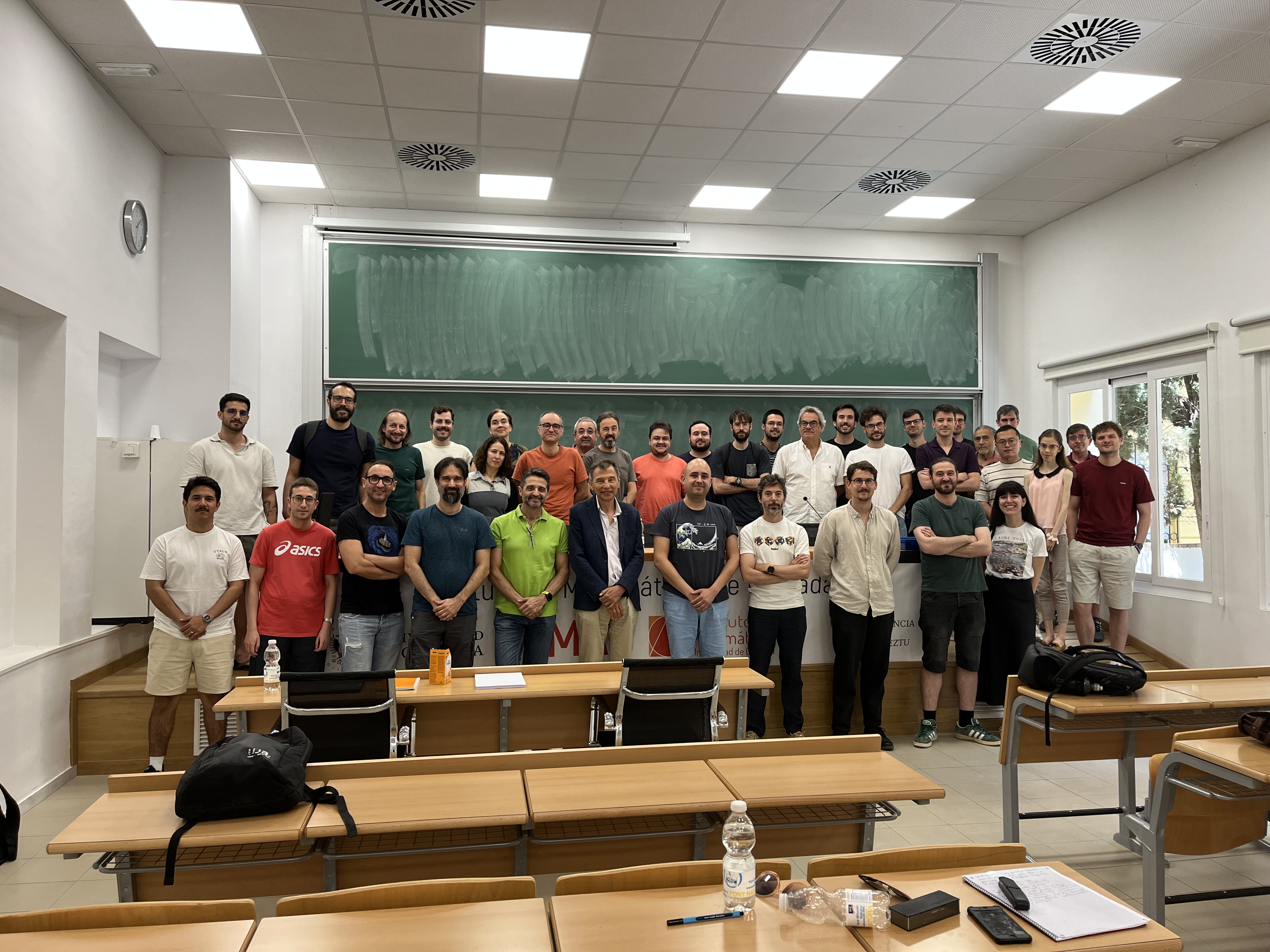
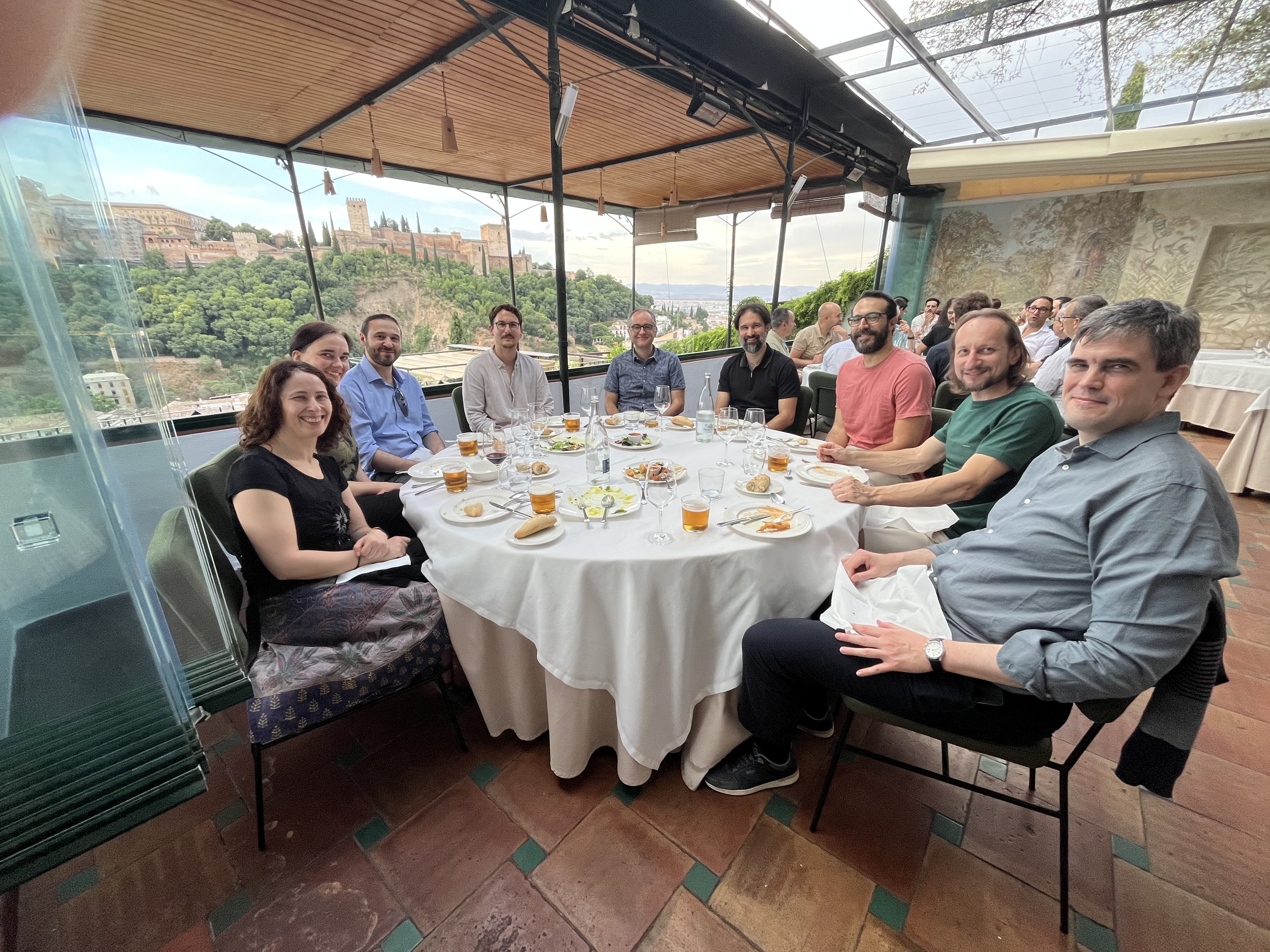
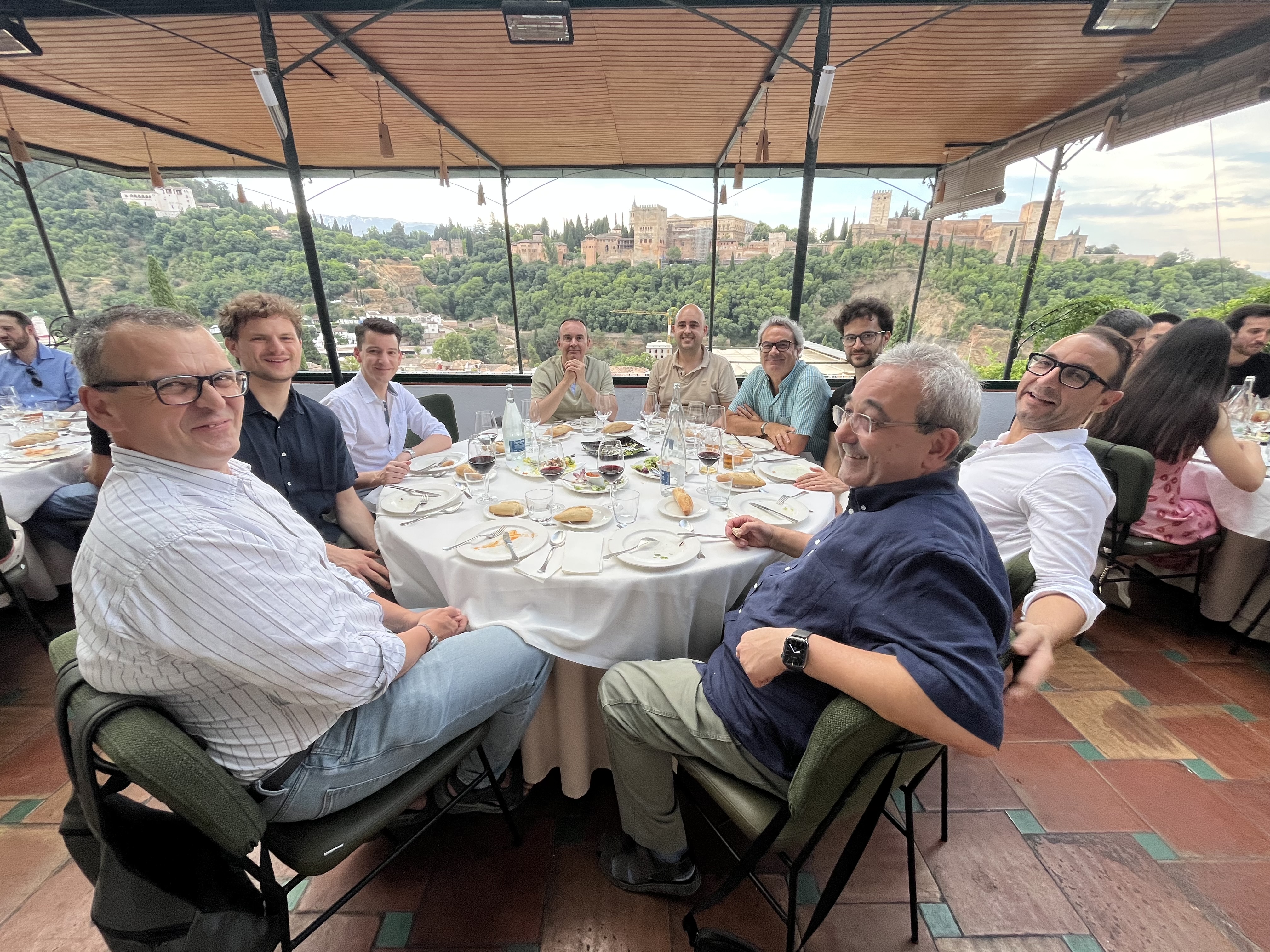
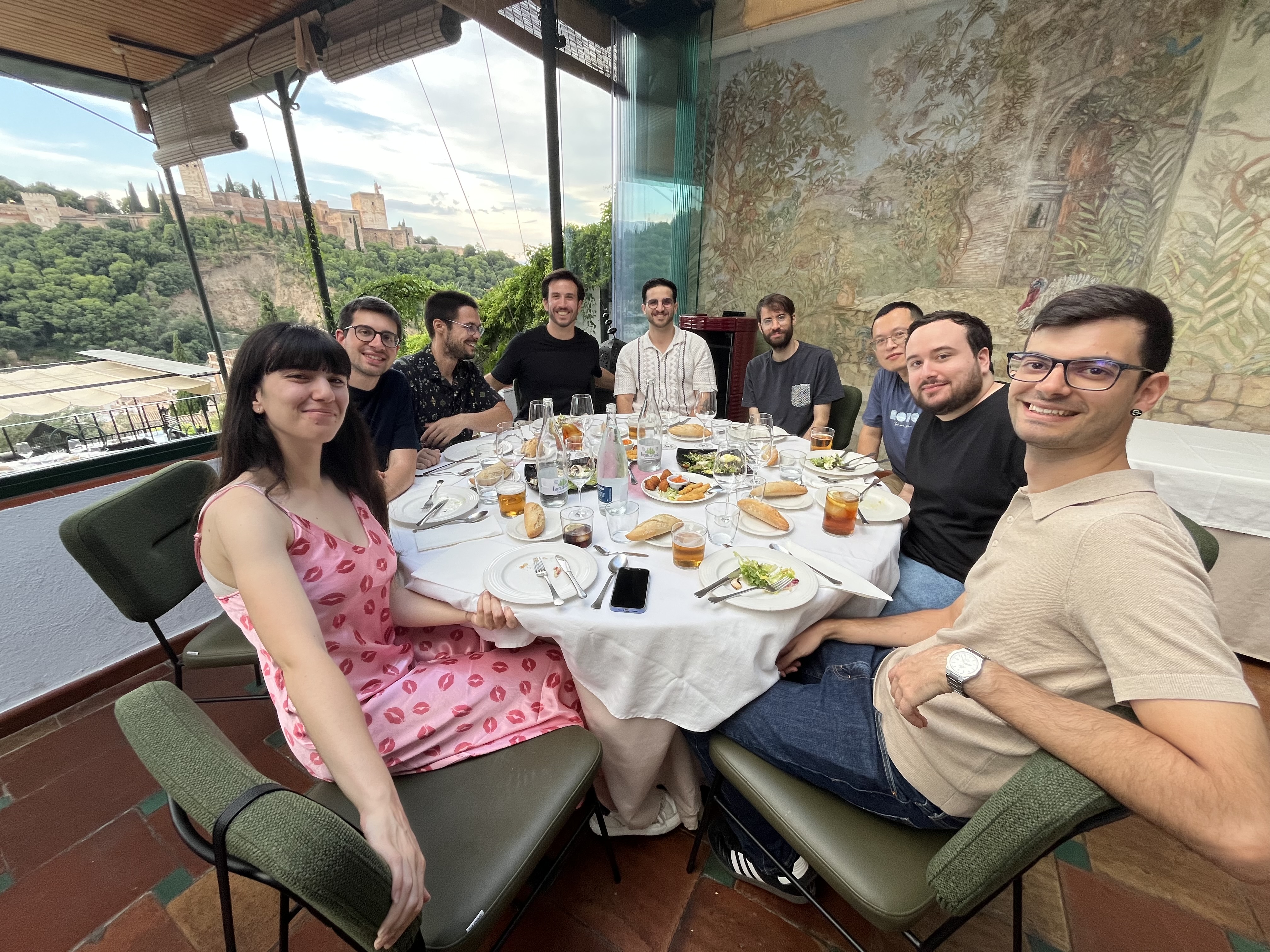
Pictures
Programme
|
Mon 15 |
Tue 16 |
Wed 17 |
Thu 18 |
| 9:05 |
opening |
Vrhovnik |
Czarnecki |
Tassi |
| 9:30 |
Mäder-Baumdicker |
Lynch |
Van der Veken |
Daniel |
| 10:20 |
Xie |
Hidalgo |
Stas |
Del Prete |
| 10:45 |
coffee |
coffee |
coffee |
coffee |
| 11:20 |
Sharp |
Martín |
I. Castro-Infantes |
J. Castro-Infantes |
| 12:10 |
Miranda |
Marín |
Pontuale |
Cerezo |
| 12:35 |
Espinar |
Sáez |
Dos Santos |
Mira |
| |
|
|
|
|
| |
|
|
|
|
| 20:00 |
|
dinner |
|
|
abstract
Ildefonso Castro-Infantes
Universidad de Murcia
Helicoidal surfaces in the Lorentz-Minkovski 3-space with prescribed mean curvature
Abstract: In this talk, we investigate the geometry of helicoidal and, specifically, rotational surfaces within the three-dimensional Lorentz-Minkowski space \(\mathbb{L}^3\). Using the linear momentum of the generatrix curves as key tool, we establish several existence and characterization results for such surfaces under a prescribed mean curvature function. This approach allows for a systematic treatment of the underlying differential equations, leading to a broader classification of these geometric configurations. The results presented are part of an ongoing research project in collaboration with Ildefonso Castro and Paula Carretero.
abstract
Jesús Castro-Infantes
Universidad Politécnica de Madrid
Genus one constant mean curvature unduloids with bi-dihedral symmetry
Abstract:
In this talk, we study the moduli space of genus-one unduloids with bi-dihedral symmetry in \(\mathbb R^3\), that is, \(H\)-surfaces of genus one with embedded ends asymptotic to unduloids. To this end, we analyze the conjugate sister surface of the fundamental piece, which is a minimal surface in \(\mathbb{S}^3\) via the Lawson correspondence. In particular, we prove that for each \(t \in (0, k\pi - 2\pi)\) there exist at least two genus-one unduloids with \(k \ge 3\) ends whose core curve of the genus-one handle has length \(t\). The limiting case \(t = 0\) corresponds to a configuration of \(k\) spheres collapsing to a single point, whereas the limit \(t = k\pi - 2\pi\) corresponds to \(k\) mutually tangent spheres. This is joint work with J. M. Manzano and J. S. Santiago.
abstract
Alberto Cerezo
Universidad de Castilla-La Mancha
Capillary minimal annuli in \(\mathbb{B}^3\) and an overdetermined problem in \(\mathbb{S}^2\)
Abstract:
For every \(n \geq 2\), we show the existence of a one-parameter real-analytic family \(\{\mathbb{A}_n(a) : a \in (0,1)\}\) of non-rotational embedded capillary minimal annuli in the Euclidean unit ball \(\mathbb{B}^3\). Each family interpolates between a capillary catenoid (as \(a \to 1\)) and a necklace of \(n\) capillary disks in \(\mathbb{B}^3\) (as \(a \to 0\)). This result provides an affirmative answer to a conjecture posed by Fernández, Hauswirth, and Mira. As a corollary, we show that the capillary analogue of the critical catenoid conjecture fails for contact angles arbitrarily close to \(\frac{\pi}{2}\).
We further use these annuli to construct families of non-radial ring domains \(\{\Omega_n(a) : a \in (0,1)\}\), \(\Omega_n(a) \subset \mathbb{S}^2\), that admit solutions to the overdetermined problem \(\Delta u + 2u = 0\) in \(\Omega_n(a) \subset \mathbb{S}^2\) with constant Dirichlet and Neumann data. This yields a negative answer to a 2005 conjecture of Souam. From an analytic viewpoint, these families can be interpreted as global bifurcation branches emerging from the set of rotational bands in \(\mathbb{S}^2\).
abstract
Maciej Czarnecki
Uniwersytet Łódzki
Mean curvature of transversally flat umbilical foliations in hyperbolic space and its generalization
Abstract:We shall describe a geometrical classification of totally umbilical codimension one foliations in hyperbolic spaces in case there is a transversal included in a hyperbolic plane. Such foliations are identified by the mean curvature function along the transversal and we analyse its behaviour.
As a generalization we provide a conformal description of the foliations based on local boosted times cones in de Sitter space.
This is a joint work with Remi Langevin.
abstract
Benoît Daniel
Institut Élie Cartan (Lorraine)
Generalized Ricci surfaces
Abstract:
It is well known that the metrics of minimal surfaces in Euclidean 3-space are locally characterized, away from points where the curvature vanishes, an equation called the Ricci condition. Quite recently, Moroianu and Moroianu obtained a full local characterization of these metrics, with possibly vanishing curvature. In this talk we will consider Riemannian surfaces satisfying a more general equation, which we call generalized Ricci surfaces. We will prove some isometric immersion theorems for other classes of surfaces, study compact generalized Ricci surfaces and make a connection with constant curvature metrics with conical singularities. This is a joint work with Yiming Zang.
abstract
Andrea Del Prete
Universidad de Jaén
Asymptotic geometry of maximal Surfaces in \(\mathrm{AdS}^3\)
Abstract:
Every complete maximal surface in Anti-de Sitter space is an entire graph and is uniquely determined by its asymptotic boundary. A natural question is whether the conformal type of the surface can be detected from the geometry of its asymptotic boundary, and vice versa.
After a brief introduction to \(\mathrm{AdS}^3\), maximal surfaces, and their relation with constant mean curvature surfaces in homogeneous three-manifolds, I will present recent results on the asymptotic behaviour of maximal surfaces through the study of their associated holomorphic quadratic differentials. The main result provides a sufficient condition ensuring the existence of lightlike segments in the asymptotic boundary. I will outline the main ideas behind the proof and present a couple of illustrative examples.
Joint work in progress with F. Bonsante.
abstract
João Paulo Dos Santos
Universidade de Brasília
Solitons to Mean Curvature Flow in the hyperbolic 3-space
Abstract:
We consider hyperbolic translators for the mean curvature flow in hyperbolic 3-space \(\mathbb H^3\), that is, initial conditions of solutions to the mean curvature flow that evolve by hyperbolic translations. We present existence and classification results for such surfaces. More specifically, we describe two distinct one-parameter families of complete rotational translators in \(\mathbb H^3\): one consisting of catenoid-type translators and the other of cylindrical translators. In addition, we show that properly immersed translators in \(\mathbb H^3\) cannot be cylindrically bounded, and we classify all translators in \(\mathbb H^3\) with nonzero constant mean curvature. We also consider rotators, namely, initial conditions of solutions to the mean curvature flow in \(\mathbb H^3\) that evolve by rotations, and we describe a one-parameter family of complete rotators, all of which are helicoidal. This extends to the hyperbolic setting a distinguished result of Halldorsson in \(\mathbb R^3\).
The talk is based on joint work with R. F. de Lima and A. K. Ramos.
abstract
José María Espinar
Universidad de Granada
Genus two embedded minimal surfaces in \(\mathbb{S}^3\) with bidihedral symmetry
Abstract:
The isometry group of the classical Lawson embedded minimal surface \(\xi_{2,1}\subset\mathbb{S}^3\) of genus \(2\) is isomorphic to the group \(D_4\times S_3\), where \(D_4\) is the dihedral group of order \(8\) and \(S_3\) the permutation group of order \(6\). The group \(\mathrm{Iso}(\xi_{2,1})\) has a subgroup of index \(3\) isomorphic to the bidihedral group \(D_{4h} = \mathbb{Z}_2\times D_4\). We will explain how to prove that \(\xi_{2,1}\) is the unique closed embedded minimal surface of genus \(2\) in \(\mathbb{S}^3\) whose isometry group contains \(D_{4h}\).
This is a joint work with J. Pérez.
abstract
Jorge Hidalgo
Universidad de Granada
Proper Bryant surfaces with arbitrary complex structure
Abstract:
Constant Mean Curvature one (CMC-1) surfaces in hyperbolic 3-space are also called Bryant surfaces after the landmark holomorphic representation by Robert Bryant in 1987. In this talk, we will present new complex analytic tools to show that every open Riemann surface admits a proper conformal CMC-1 immersion into hyperbolic 3-space.
This is joint work with Antonio Alarcón.
abstract
Stephen Lynch
King's College London
Canonical foliation of bubblesheets
Abstract:
I will introduce a curvature condition for submanifolds of higher codimension which generalises constant mean curvature hypersurfaces and parallel mean curvature submanifolds. Using this new curvature condition, one can produce canonical foliations for Riemannian manifolds which are close to a product metric via the implicit function theorem. This is useful for constructing canonical parameterizations of certain high-curvature regions, called bubblesheets, which arise along the Ricci flow.
abstract
Elena Mäder-Baumdicker
Freie Universität Berlin
The Willmore energy landscape and singularities of the Willmore flow
Abstract:
Due to work of Kuwert and Schaetzle, it is known that the Willmore flow of immersed spheres in Euclidean 3-space does not develop singularities and converges to a round sphere when the initial sphere has energy below \(8\pi\). Together with a theorem of Banchoff and Max, this implies that the space of spherical immersions with energy below \(8\pi\) equipped with the \(C^1\)-topology has two connected components. In this talk I will explain how this generalizes to the next interesting energy level, namely \(12\pi\). In this regime there are four connected components with respect to regular homotopy. When starting the Willmore flow in two of these components, it inevitably develops a singularity. The methods to prove these results involve singularity analysis, gluing methods and techniques from low-dimensional topology based on combinatorial information on self-intersections. Since the only critical points of the Willmore functional of spherical type are inverted complete minimal surfaces with finite total curvature, one hopes to show convergence if the initial surface is chosen in one of the two 'good' connected components. This talk is based on work with Jona Seidel.
abstract
Diego A. Marín
Universidad de Granada
Geometry of \(f\)-extremal domains in the 2-sphere
Abstract:
Given a Riemannian manifold \((M,g)\) and a Lipschitz function \(f \in \mathcal{C}(\mathbb{R}^2)\), we say that a domain \(\Omega \subset M\) with \(\mathcal{C}^2\)-boundary is an \(f\)-extremal domain if it supports a solution to the overdetermined elliptic problem (OEP) \begin{eqnarray} \label{OEP}\left\{\begin{array}{llll}\Delta{u} + f(u, |\nabla u|) = 0 &\mathrm{in}~\Omega,\\u > 0 &\mathrm{in}~\Omega, \\u = 0 &\mathrm{on}~\partial\Omega,\\ \langle\nabla{u},\eta\rangle = \alpha_i &\mathrm{on}~\Gamma_i \subset \partial \Omega,\end{array}\right.\end{eqnarray} where \(\eta\) is the outer conormal to \(\partial \Omega\) and \(\alpha_i \leq 0\) is a constant on each connected component \(\Gamma_i \subset \partial \Omega\).
It is a well known fact in the literature that the theory of the existence and rigidity of \(f\)-extremal domains is closely linked to the theory of constant mean curvature surfaces (CMC) in \(M\).
In this talk, we will explore this connection for \(f\)-extremal domains in \(\mathbb{S}^2\). In particular, using techniques from the theory of CMC-surfaces, we will prove that, under certain conditions on the function \(f\) and the topology of the domain \(\Omega\), an \(f\)-extremal domain in \(\mathbb{S}^2\) must exhibit significant symmetry. If time permits, we will also show how these techniques can be applied to study capillary CMC surfaces in the unit ball, a topic that has received a great deal of attention in recent years.
This talk is based on joint work with my supervisor, José M. Espinar.
abstract
Francisco Martín
Universidad de Granada
Minimal surfaces with rapid area growth
Abstract:
In this joint work with Tobias H. Colding and William P. Minicozzi II, we exhibit properly immersed minimal surfaces in Euclidean space with very rapid extrinsic area growth. Our first example is a proper minimal embedding in \(\mathbb{R}^4.\) It is stable, and therefore shows that stability does not preclude area growth far beyond the polynomial regime. Our second example is a proper minimal immersion in \(\mathbb{R}^3,\) obtained by adapting classical constructions of proper minimal surfaces with prescribed conformal and asymptotic behavior. This gives codimension-one examples whose area in extrinsic balls grows extremely fast. These constructions demonstrate that properness alone imposes essentially no effective upper bound on extrinsic area growth, even for minimal surfaces, and they clarify the role of additional large-scale hypotheses in results that force polynomial volume growth.
abstract
Pablo Mira
Universidad Politécnica de Cartagena
Minimal surfaces and periodic Serrin bands
Abstract:
A Serrin domain is a smooth domain of \(\mathbb{R}^n\) where the Dirichlet solution to \(\Delta u+2=0\) has a constant Neumann value along its boundary. Compact Serrin domains are balls after the famous theorem by J. Serrin. In the non-compact case, the simplest Serrin domains are the slabs of \(\mathbb{R}^2\) between two parallel lines. But in this case, after works by Fall-Minlend-Weth and Dávila, Del Pino, Musso and Wheeler, it is known that there exist periodic Serrin domains with the topology of a band that are not slabs. In this talk we will use ideas from minimal surface theory and integrable systems to study the classification problem of Serrin bands. We will give a structure theorem for all possible periodic Serrin bands via the mKdV hierarchy, and construct a global 1-parameter moduli space of such examples. We will also discuss the conjecture that any Serrin band in \(\mathbb{R}^2\) should be an element of this 1-parameter family.
Joint work with Alberto Cerezo and Isabel Fernández.
abstract
Ivan Miranda
Instituto de Matemática Pura e Aplicada
Finite index constant mean curvature hypersurfaces in low dimensions
Abstract:
We prove that every complete finite index immersed CMC hypersurface is either minimal or compact, provided that the ambient six-dimensional manifold is a Riemannian product of a closed manifold with non-negative sectional curvature and a Euclidean factor. This answers affirmatively a question posed by do Carmo, for this class of ambient spaces, and extends known lower dimensional results. As a consequence, we complete the classification of two-sided, complete weakly stable CMC hypersurfaces immersed in the space forms of positive curvature in dimension six. We also prove that a complete, finite index CMC hypersurface immersed in the hyperbolic six-space with mean curvature \(|H|>7\) is compact. This gives a partial answer to a question posed by Chodosh in his survey for the ICM.
abstract
Claudia Pontuale
Università degli Studi dell'Aquila
Stability of constant mean curvature hypersurfaces and Do Carmo's problem
Abstract:
Do Carmo’s problem asks whether a complete, noncompact, stable hypersurface with constant mean curvature in Euclidean space must necessarily be minimal. After briefly recalling some known results, we present a partial answer under a natural assumption on the Ricci curvature. The result applies in arbitrary dimension.
This is a joint work with Barbara Nelli.
abstract
Mariel Sáez
Pontificia Universidad Católica de Chile
Special solutions to Mean Curvature Flow on three-manifolds with Lie group structure
Abstract:
In this talk, I will describe the construction of special solutions to the Mean Curvature Flow on three-manifolds endowed with a Lie group structure.
In the first part, I will focus on solutions arising from initial hypersurfaces determined by subgroups. In contrast to the Euclidean setting, this framework admits several nontrivial examples of such solutions. In the second part, I will discuss grim reaper–type solutions in the same geometric context and compare them with previously known examples.
This is joint work with R. Arroyo and Gabriela Ovando.
abstract
Ben Sharp
University of Leeds
Embedded minimal surfaces in closed analytic 3-manifolds
Abstract:
When the area functional is analytic we should expect minimal surfaces to be either isolated or to belong to smooth nearby minimal foliations. On the other hand the flat plane of multiplicity two in \(\mathbb{R}^3\) can be (in compact regions) approximated by a blown-down catenoid, which will converge back to the plane with multiplicity two in the limit —so a plane of multiplicity two cannot be thought of as being isolated, or belonging solely to a smooth family, because there are nearby minimal surfaces of distinct topology weakly converging to it. I will discuss an ongoing joint work with Luigi Appolloni and Andrea Malchiodi which shows that when the ambient manifold is closed and analytic, this type of catenoid-singularity does not occur. On the contrary we will also discuss a smooth and non-analytic three-manifold where catenoid singularities can happen. In particular we are able to conclude that the area spectrum of index one embedded minimal surfaces is discrete in an analytic ambient 3-manifold.
abstract
Giel Stas
KU Leuven
Parallel mean curvature spheres in the product of the two-sphere and the hyperbolic plane
Abstract:
We discuss classification results for parallel mean curvature surfaces in the product of a two-sphere and a hyperbolic plane (with opposite sectional curvatures). In particular, we prove a reduction of codimension for PMC spheres. This is an extension of a result by Torralbo and Urbano concerning PMC surfaces in the product of two surfaces with equal constant curvatures.
abstract
Marcos Tassi
Universidad de Granada
Elliptic Weingarten surfaces in \(\mathbb{R}^3\) with convex planar boundary.
Abstract:
A surface \(\Sigma\) immersed in \(\mathbb{R}^3\) is an elliptic Weingarten surface if its principal curvatures \(k_1\) and \(k_2\) satisfy an equation of the type \(W(k_1,k_2)=0\), for some function \(W:\mathbb{R}^2 \rightarrow \mathbb{R}\) of class \(C^1\) such that \(\frac{\partial W}{\partial k_1}\frac{\partial W}{\partial k_2} > 0\) on \(W^{-1}(\{0\})\). Known examples of elliptic Weingarten surfaces include minimal and constant mean curvature surfaces, and surfaces of positive constant gaussian curvature.
In 1996 A. Ros and H. Rosenberg proved that for a strictly convex curve \(\Gamma \subset \{z=0\} \subset \mathbb{R}^3\), there exists a constant \(h\) depending only on the curve \(\Gamma\) such that any compact surface embedded in \(\mathbb{R}^3_+:= \{z \geq 0\}\) with constant mean curvature \(H \leq h\) must be topologically a closed disk.
In this talk we will present a generalization of Ros-Rosenberg Theorem for elliptic Weingarten surfaces in \(\mathbb{R}^3\), whose proof is based on some geometric analysis techniques as the Maximum Principle and the Alexandrov Reflection Method, and the recent classification of elliptic Weingarten surfaces of revolution obtained by I. Fernandez and P. Mira.
This is a joint work with B. Nelli and G. Pipoli.
abstract
Joeri Van der Veken
KU Leuven
On minimal homogeneous submanifolds of the hyperbolic space
Abstract:
A fundamental question in submanifold theory is the following: How does the intrinsic geometry of a Riemannian manifold influence the possible isometric immersions of that manifold?
. Of particular interest is the case where the ambient space has constant sectional curvature. In the present work we consider Riemannian manifolds that are (intrinsically) homogeneous, i.e., their isometry groups act transitively. It is conjectured that a minimal isometric immersion of such a homogeneous Riemannian manifold into a Euclidean or hyperbolic space must be totally geodesic. For hypersurfaces, this follows from classification results by Nagano and Takahashi, but there are only few results in higher codimension. In this joint work with Felippe Guimarães (Federal University of Rio de Janeiro), we prove the conjecture for minimal isometric immersions of homogeneous Riemannian manifolds of dimension at least 5 and codimension 2 in hyperbolic spaces.
abstract
Tjaša Vrhovnik
Universidad de Granada
Minimal surfaces of weak finite total curvature
Abstract:
Complete minimal surfaces of finite total curvature are among the simplest ones and play an important role in understanding the global theory of minimal surfaces. The complex structure and Weierstrass data of such surfaces are well-understood, as well as a number of classical results of Chern-Osserman, Jorge-Meeks, and others. The notion of complete minimal surfaces of finite total curvature was generalized by López, who introduced surfaces of weak finite total curvature in 2014. In this talk we connect them with the study of global properties, characterizing those open Riemann surfaces which are the complex structure of a proper minimal surface in \(\mathbb{R}^n\) (\(n\geq 3\)) of weak finite total curvature. The core of the characterization result lies in the Mittag-Leffler theorem for proper minimal surfaces in \(\mathbb{R}^n\), which we also establish for a more general family of directed meromorphic curves in \(\mathbb{C}^n\).
The talk is based on joint work with Antonio Alarcón.
abstract
Zhenxiao Xie
Beihang University (Beijing)
On the first eigenvalue of the area Jacobi operator for complex curves in Kähler manifolds
Abstract:
In this talk, I will first show how Montiel-Urbano's conformally invariant functional \(W^+\) can be used to derive a lower bound for the first eigenvalue of the area Jacobi operator on complex curves in Kähler surfaces. The bound is expressed in terms of the infimum of the ambient Ricci curvature (which can be seen as an extrinsic analogue of the classical Lichnerowicz theorem for the Laplace–Beltrami operator), and on a Kähler-Einstein surface with positive Einstein constant \(c\), it reduces to \(2c\). In this setting, the bound is attained by all complex curves of genus \(g \leq 1\). I will then introduce a conformally invariant functional for closed real surfaces in higher dimensional Fano manifolds, and show how it yields both lower and upper bounds for the first eigenvalue of the area Jacobi operator on holomorphic curves therein.
How to get to IMAG
The Maths Institute is located next to the Faculty of Social Sciences of the University of Granada. To get there, you have to access via the Faculty of Social Sciences or via the Documentation Center, both located in the street Rector López Argüeta.